Congratulations, Your Chaotic Closet Was Avant-Garde the Whole Time: The $399 Outfit Archaeology Racket
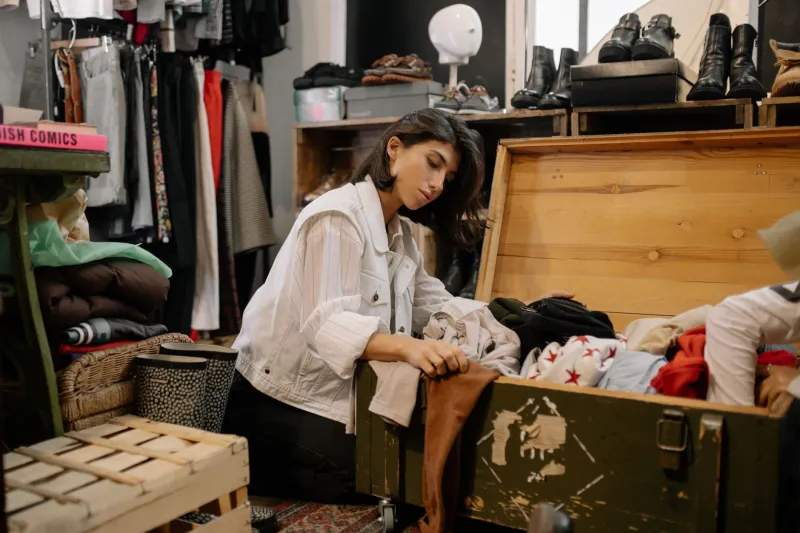
Kayla from Scottsdale has, by her own admission, never made a deliberate fashion decision in her life. Her closet is an archaeological record of impulse purchases, sale-rack gambles, a brief and confusing phase involving ponchos, and approximately eleven years of buying whatever seemed fine at the time. There is a denim vest. There are wide-leg trousers she bought before wide-leg trousers were back, abandoned when they felt wrong, and retained because throwing things away requires a level of decisiveness she has not yet located.
Kayla recently paid $399 to be told she is a visionary.
The service is called "Closet Archaeology," and it is one of perhaps two dozen similar offerings that have proliferated across boutique styling platforms and independent fashion consultants in the past eighteen months. The premise is straightforward, the execution is theatrical, and the psychological payoff is, for a remarkable number of clients, genuinely satisfying: a trained professional examines your existing wardrobe and retroactively reframes every questionable purchase as intentional, prescient, or culturally significant.
Kayla's denim vest, it turns out, is "raw denim deconstruction with post-ironic Western undertones." The ponchos were "pre-Andean revival statement layering." The wide-leg trousers she bought in 2018 were not a mistake — they were "prescient silhouette leadership."
She was, the consultant confirmed, ahead of the curve the entire time. She just hadn't known to look at it that way.
The Methodology: Retrofitting Legitimacy Onto Random Decisions
Outfit archaeology services operate on a principle that is philosophically interesting when examined directly: that fashion legitimacy is not inherent to a garment but is instead a function of framing, timing, and vocabulary. A Juicy Couture velour tracksuit purchased in 2003 because it was comfortable and the rhinestones felt fun is, in 2024, either an embarrassing relic or "proto-Y2K maximalism with logomania undertones" — and the only thing separating those two interpretations is whether anyone has bothered to apply the right language to it.
Consultants in this space are, first and foremost, practitioners of retroactive narrative construction. They arrive at a session — conducted either in-home or via detailed photo submissions — with a working knowledge of fashion history, a fluency in current critical vocabulary, and an apparently infinite capacity for finding the trend framework that validates whatever they're looking at.
The process typically involves three stages:
The Excavation, in which every item is pulled from the closet, photographed, and catalogued. Consultants describe this phase using the language of actual archaeology — "unearthing," "site mapping," "artifact identification" — with a commitment that suggests they briefly considered bringing brushes and a grid system.
The Dating and Classification, in which each piece is assigned to a trend lineage. This is where the service earns its fee. The consultant must locate every item, no matter how random its origins, within a coherent historical narrative. A Forever 21 blazer from 2015 becomes "transitional post-recession power dressing." A pair of platform sneakers bought because they were on clearance becomes "early maximalist footwear discourse." A sequined top purchased for a bachelorette weekend in Nashville becomes "celebratory excess as political statement."
The Curation Report, a formal document delivered to the client detailing their "unconscious aesthetic lineage" and confirming that their closet, read correctly, tells the story of someone who was paying attention.
The Vocabulary Is the Product
It is worth spending a moment with the terminology, because the terminology is doing almost all of the work.
"Proto" is the industry's most versatile prefix. Anything purchased before a trend officially arrived can be described as "proto-[trend name]," which transforms early adoption — or, more accurately, accidental proximity to a trend that hadn't happened yet — into evidence of foresight. The tracksuit wasn't unfashionable; it was proto-Y2K maximalism. The bucket hat wasn't a mistake; it was proto-gorpcore.
"Discourse" is similarly load-bearing. Attaching the word "discourse" to any garment category elevates the item from clothing into cultural commentary. You didn't buy cargo pants because they had pockets; you were "engaging with utilitarian discourse." The implicit suggestion is that your shopping trip was, in some meaningful sense, an intellectual act.
"Unconscious curation" is perhaps the most generous concept in the outfit archaeology toolkit. It addresses the obvious problem with the entire service — namely, that most clients did not curate their wardrobes intentionally — by reframing intentionality as optional. You don't need to have meant to build a coherent aesthetic. Your subconscious was doing it for you. The chaos was actually a system. You just needed someone with a $399 consultation fee to decode it.
The Clients Are Not Foolish. They Know Exactly What They're Buying.
The most common assumption about outfit archaeology clients is that they're being taken advantage of — that they genuinely believe the consultant's retroactive framing represents some objective truth about their wardrobe. This assumption is largely wrong, and getting it wrong misses what makes the service interesting.
Most clients, when pressed, will acknowledge that the reframing is partially constructed. They know the sequined Nashville top wasn't a political statement. They were aware, in the moment, that the poncho phase was not going great. What they're purchasing is not historical accuracy but permission — the formal, professionally delivered authorization to stop being embarrassed about their own closet and start reading it as something other than a record of failures.
One client, a 41-year-old teacher in Portland, described the experience with disarming clarity: "I knew she was kind of making it up. But she was making it up in a way that made me feel like my whole wardrobe finally made sense. And honestly? That's worth $399 to me."
This is, when examined without judgment, a coherent value proposition. The fashion industry has always sold narrative alongside fabric. Outfit archaeology has simply removed the new garment from the transaction and applied the narrative to what you already own.
The Business Is Expanding, Naturally
Several outfit archaeology services have begun offering tiered packages. The base tier covers existing wardrobe validation. Premium tiers add "predictive trend positioning" — identifying items you currently own that will become culturally significant in the future, so you can feel retroactively smug about them in advance. One service offers a $699 "Legacy Closet" package that produces a bound, printed document describing your wardrobe as a historical archive suitable for, and this is a direct quote, "eventual museum consideration."
Kayla from Scottsdale has not yet purchased the Legacy package. But she is, she admits, thinking about it.
The denim vest is already mounted on a proper hanger. The ponchos have been moved to a more prominent position. The wide-leg trousers, her prescient silhouette leadership, hang in a place of honor.
She was ahead of the curve the whole time.
Someone finally told her so. It cost $399.
It was, she maintains, completely worth it.