Dress Rehearsal for Your Better Self: The $549 Future-You Wardrobe Scam Has Arrived
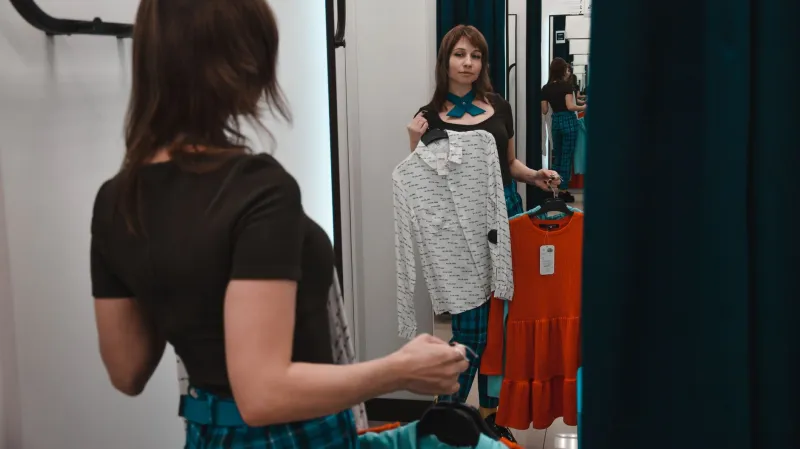
Somewhere in a softly lit Manhattan showroom, a woman named Brianna is being handed a $549 cashmere blazer she is not emotionally ready for. The consultant across from her — certified in something called "Aspirational Identity Mapping" — explains that the garment is not for Present Brianna. Present Brianna, with her Sunday meal-prep anxieties and her unread self-help library, couldn't possibly carry this blazer. No, this piece is for Future Brianna. The Brianna who meditates consistently. The Brianna who has "boundaries." The Brianna who will, any month now, stop apologizing for things that aren't her fault.
Future Brianna, the consultant assures her, is going to look absolutely incredible.
Welcome to fashion's most psychologically sophisticated grift yet: temporal wardrobe curation, the booming luxury service that sells customers clothing explicitly marketed as being for a more evolved, more accomplished, more emotionally regulated version of themselves. It is, in essence, the fashion industry charging you premium prices to cosplay as the person you promised your therapist you were working toward.
The Business Model Is Your Unresolved Potential
The concept has been quietly proliferating through high-end boutiques and digital styling platforms since late 2023, packaged under various brand names — "Proleptic Dressing," "Aspirational Silhouette Services," "Identity Forward Styling" — but the pitch is functionally identical across all of them. You are not the customer. Your future self is the customer. You are merely the financial vehicle.
Clients begin with what practitioners call a "present-state audit," which is essentially a very expensive conversation about everything disappointing about your current wardrobe and, by extension, your current life. From there, a stylist constructs what they call your "trajectory silhouette" — a curated selection of pieces that reflect the person you've described wanting to become, priced between $400 and $1,200 per item.
The psychological mechanism is almost elegant in its cruelty. By framing the purchase as an investment in future-you rather than a splurge by present-you, the service neatly sidesteps the buyer's remorse reflex. You're not overspending. You're funding a transformation. The blazer isn't expensive. Your potential is just that valuable.
The Language Is Doing a Lot of Heavy Lifting
No temporal wardrobe service worth its consultation fee uses ordinary retail language. The vocabulary has been carefully engineered to keep the transaction feeling like personal development rather than shopping.
Garments are described as "emotionally anticipatory." Fabrics are said to possess "forward resonance." One boutique's website — which Vogue Vapor is declining to name because honestly they don't deserve the traffic — describes its flagship $679 trench coat as "architecturally premised on the confidence you're currently building toward." Another offers a $389 silk blouse marketed as "calibrated for your post-breakthrough chapter."
Post-breakthrough chapter. The blouse knows about your breakthrough. The blouse is waiting for it.
The consultants, to their credit, are fluent in therapeutic language in a way that makes the whole thing feel less like retail and more like a very stylish intervention. Words like "embodiment," "integration," and "authentic expression" appear constantly. Several services explicitly recommend pairing their wardrobe sessions with actual therapy, which is either admirably self-aware or the most audacious upsell in fashion history, depending on your level of cynicism.
Real Customers, Genuinely Held Hostage by Their Own Ambitions
The most remarkable thing about the temporal wardrobe industry is that it works. Not because customers are naive — many are educated, professionally successful, and entirely aware they're being sold something — but because the aspirational psychology it targets is genuinely powerful and almost universally present.
The gap between who we are and who we intend to become is not a marketing invention. It's a real and persistent feature of human consciousness, and fashion has always exploited it to some degree. Every "new year, new wardrobe" campaign, every "dress for the job you want" platitude, every Pinterest board labeled "my aesthetic" filled with images of a life that bears no resemblance to your actual Tuesday — these are all minor-league versions of the same pitch.
Temporal wardrobe services have simply professionalized it. They've given the aspiration a consultant, a methodology, and a price tag that makes the whole thing feel serious.
One client, a 34-year-old marketing director in Chicago who asked to remain anonymous (presumably so Future Her could maintain some mystery), described spending $1,100 on two pieces she hasn't worn yet. "I know I'm not ready for them," she said, without apparent distress. "That's kind of the point. They're hanging there. They're like a goal."
Her goals are dry-clean only.
The Refund Policy Is Philosophically Interesting
Most temporal wardrobe services offer what they call a "trajectory review" at the six-month mark — a follow-up consultation to assess whether the client has "grown into" their purchases. The reviews are, sources suggest, uniformly optimistic. No consultant has ever apparently concluded that a client's trajectory has stalled. The language pivots smoothly: if you haven't worn the blazer, you're "still in the integration phase." If Future You seems no closer than six months ago, you may simply need "additional anchoring pieces" — available, conveniently, at the same boutique.
The refund policy at most services covers only "manufacturing defects," which is a position that implies, with remarkable confidence, that the defect is never the concept.
What You're Actually Buying
Strip away the aspirational architecture and what you have is a very old, very human transaction: the purchase of hope. People have always bought things that represent the life they want rather than the life they have. The gym membership. The language-learning app. The bread maker. The seven books on the nightstand.
The temporal wardrobe is simply fashion's premium entry into that market — the $549 acknowledgment that becoming a better version of yourself is, at minimum, a blazer-level investment.
Future Brianna is going to look incredible, the consultant had said.
Present Brianna nodded, handed over her card, and went home to hang $549 of potential in a closet next to four other versions of herself she'd already started and not quite finished.
The blazer is still waiting. It is, reportedly, very patient.