A Complete Field Guide to Americans Who Turn Every Mall Visit Into a One-Person Anti-Consumerism Rally

The American shopping mall, once declared dead by every think piece published between 2015 and 2020, has proven irritatingly resilient. And nowhere is that resilience more richly illustrated than in the specific behavioral ecosystem of the consumer who does not believe in consumerism and is at the mall anyway, narrating their own presence there as though it were an act of political courage.
They are everywhere. They are purchasing things. They are extremely vocal about the philosophical framework that makes this okay.
Vogue Vapor's field researchers — stationed at malls across America with clipboards, uncomfortable shoes, and a gradually deepening sense of existential dread — have spent the better part of a season cataloguing these magnificent specimens. What follows is the definitive taxonomy.
Species #1: The Anti-Capitalist With the Nordstrom Credit Card
Habitat: The contemporary department store, specifically the section where the good stuff is.
Identifying Features: Carries a canvas tote from an independent bookstore. Wearing a vintage-looking jacket that is not actually vintage. Has an opinion about Amazon that they will share before you have finished saying hello.
Behavioral Pattern: The Anti-Capitalist With the Nordstrom Credit Card has achieved a state of philosophical equilibrium that lesser minds might call contradiction but which they experience as nuance. They oppose the system, obviously. They also have the Nordy Card because the points are genuinely very good and the anniversary sale is not something you simply skip.
Observed in the wild, they can typically be found selecting items from the sale rack while delivering a sotto voce monologue about the exploitative labor practices of the fashion industry. They will buy the blouse. They will feel complicated about it. They will wear it to a protest.
Signature Phrase: "I'm not supporting them, I'm redistributing from within the system."
Species #2: The Minimalist Who Shops Seasonally (Every Season)
Habitat: Any store with clean sightlines and a muted color palette. Particularly comfortable at Everlane, COS, and the quieter sections of Banana Republic.
Identifying Features: Owns, by their own account, exactly thirty-three items of clothing. This number has been thirty-three for four years. The math does not work and no one is allowed to mention it.
Behavioral Pattern: The Minimalist Who Shops Seasonally has constructed an elegant ideological architecture in which every new purchase is not an addition but a replacement — part of an ongoing, rigorous curation process that keeps their wardrobe intentional, edited, and perpetually the same size despite the continuous arrival of packages.
They shop with the focused intensity of a procurement officer. Each item is held at arm's length and evaluated against a mental checklist that includes "timeless," "versatile," "ethically produced," and "does not remind me of who I was in 2018." They will spend forty-five minutes on a single cream-colored crewneck. They will buy it. They will go home and "release" something else into the wild, which means giving it to a friend and telling them it's a gift.
Signature Phrase: "I'm not buying more, I'm refining."
Species #3: The Radical Act of Self-Care Shopper
Habitat: Anywhere with mood lighting and a loyalty program.
Identifying Features: Arrived at the mall "just to walk around." Has been here for three hours. Is carrying a Cinnabon.
Behavioral Pattern: The Radical Act of Self-Care Shopper has internalized the cultural messaging of the last decade so completely that the act of purchasing a $68 candle is, for them, genuinely indistinguishable from therapy. Every acquisition is reframed, in real time, as an act of emotional maintenance. The moisturizer is healing. The throw blanket is boundaries. The second pair of nearly identical black pants is, apparently, a form of grief processing.
They do not shop. They practice. They are not spending money. They are, in the language they deploy with impressive frequency, "investing in their peace." The credit card statement, when it arrives, will not prompt reflection. It will prompt a conversation with their therapist about why they feel guilty for prioritizing themselves.
Signature Phrase: "I needed this." (Delivered about a decorative tray.)
Species #4: The Ironic Purchaser
Habitat: Any store they claim to find embarrassing. Hot Topic. Spencer's. The entire square footage of a Spirit Halloween.
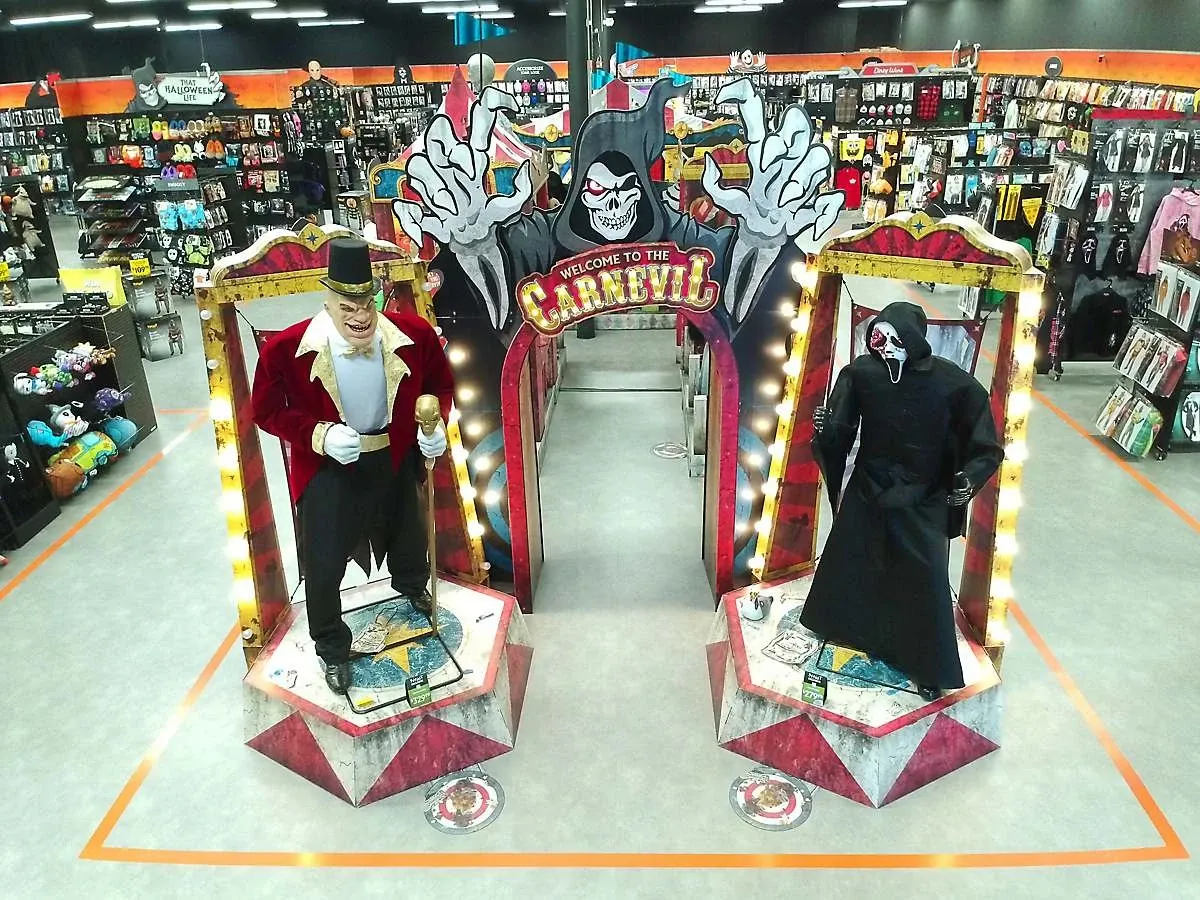 Photo: Spirit Halloween, via static.wikia.nocookie.net
Identifying Features: Is buying something. Is making a face that communicates they are not really buying something. Has used the word "camp" twice in the last four minutes.
Behavioral Pattern: The Ironic Purchaser has developed a sophisticated defensive apparatus that allows them to consume anything — absolutely anything — without it reflecting on their taste, because they are purchasing it ironically. The sequined fanny pack is ironic. The novelty socks are ironic. The fact that they wear the novelty socks every Tuesday is also, somehow, ironic, though the specific mechanism is unclear.
The beauty of the ironic purchase is its total unfalsifiability. There is no item so sincere that it cannot be rendered ironic by the application of a knowing smile and the phrase "it's giving..." followed by something the speaker finds amusing. They are not accountable to their shopping cart. They are observers of it.
Signature Phrase: "Oh, I know it's terrible. That's why I love it."
Species #5: The Researcher
Habitat: Every store in the mall, sequentially, for several hours, culminating in a purchase at the first store they entered.
Identifying Features: Has a note on their phone that is a comparative grid of options. The grid has seventeen rows. They are not going to use the grid.
Behavioral Pattern: The Researcher does not shop. They assess. Shopping is impulsive, reactive, a capitulation to marketing. What the Researcher does is conduct due diligence — a systematic survey of available options, grounded in objective criteria, that happens to end with them buying the thing they liked immediately and instinctively three hours ago.
They have read twelve Reddit threads about this purchase. They have watched four YouTube reviews. They have a spreadsheet. The spreadsheet has conditional formatting. They are going to buy the first thing they saw.
Signature Phrase: "I just want to make sure I'm making an informed decision." (Said while holding the thing they already decided to buy.)
Species #6: The Local Economy Supporter (Who Is at the Mall)
Habitat: Technically, they prefer local small businesses. Practically, they are at the Anthropologie.
Identifying Features: Will mention, unprompted, that they usually shop local. Is not currently shopping local. Is touching a $148 throw pillow.
Behavioral Pattern: The Local Economy Supporter has a genuine, heartfelt commitment to patronizing independent businesses and keeping money in their community. They also have a mall within seven minutes of their house, ample parking, and a 20% off coupon that expires today. These facts coexist in their mind not as a contradiction but as a temporary, justifiable exception that has been occurring on a weekly basis since 2019.
They will feel slightly guilty about this. They will compensate by buying something from a farmer's market on Sunday. The farmer's market item will cost $14 and be a small jar of honey. The Anthropologie throw pillow will cost $148. The moral math, in their accounting, will balance.
Signature Phrase: "I'm going to make up for this at the farmer's market."
A Note From the Field
What unites these six magnificent species — and the dozens of sub-variants our researchers documented but lacked space to fully catalogue — is a shared and deeply American conviction that consumption, if properly narrated, is something other than consumption. That the story you tell about why you bought something is as important as what you bought. That the right philosophical framework can transform a Saturday at the mall into an act of cultural resistance, emotional healing, or rigorous intellectual inquiry.
This conviction is, of course, precisely what the mall was designed to produce. But try telling them that while they're in line at the Cinnabon.
They'll explain why the Cinnabon is actually fine.